

Automate io: the untapped potential of automation in businesses
Businesses today move fast. Customer expectations are high, teams use dozens of apps, and manual work slows everything down. That’s where automation steps in. Tools designed for business workflow automation now help companies connect apps, eliminate repetitive tasks, and streamline operations without complex coding.
One platform that helped popularize this shift is automate io. It enables companies to link apps, automate processes, and move data between systems effortlessly. From startups to large enterprises, organizations are discovering how automation reduces errors, improves productivity, and frees teams to focus on meaningful work.
The rise of automation: how automate io is leading the charge
Automation has transformed how companies handle daily operations. Instead of copying data from one platform to another, teams now rely on workflow management software and SaaS automation tools to perform these tasks automatically. Businesses that adopt automation often notice improved efficiency, faster response times, and fewer manual errors.
In many cases, tools like automate io serve as the bridge connecting apps and workflows. Whether it’s syncing marketing platforms, CRM systems, or customer support tools, automation allows data to flow seamlessly. This shift toward digital workflow management is becoming a core strategy for organizations aiming to stay competitive.
Related post: How low code mendix is changing the future of software development
Automation’s growth spurt: how automate is changing the game
Automation has grown rapidly in recent years. Companies are realizing that repetitive work drains valuable time. Tasks like data entry, report updates, and file transfers can now run automatically through automated business processes.
For example, imagine a marketing team receiving leads through a form. With automation in place, that lead can instantly be added to a CRM, trigger a welcome email, and update a sales dashboard. This kind of automate.io workflow automation removes bottlenecks and keeps teams focused on strategy instead of admin work.
Unlocking the power of integrations: bringing your tools together
Most companies rely on dozens of apps every day. Email platforms, CRM systems, project management tools, and cloud storage services all hold valuable data. Without integration, these systems operate in isolation.
Automation platforms act as app integration tools that connect these systems together. For instance, automate.io integrations allow businesses to link tools like Google Sheets, CRM platforms, and email services so information flows automatically. Instead of switching between apps, teams can trust their workflows to handle the work behind the scenes.
Real-time data management: laying the foundation for success
Modern businesses rely on up-to-date information. Whether it’s customer data, inventory updates, or marketing metrics, decisions depend on accurate data. Automation tools help maintain consistency through automated data transfer and instant syncing.
With data synchronization tools, information stays updated across platforms. When a customer record changes in one system, the update instantly appears in others. This prevents outdated records and helps teams maintain reliable customer communication.
Expert voices: why automation is a business no-brainer
Industry analysts consistently highlight automation as a key driver of business productivity. Many organizations now automate routine processes such as customer onboarding, invoice management, and marketing workflows.
Experts also emphasize that automation improves customer experience. Faster responses, fewer errors, and consistent communication create trust. With platforms like automate io, businesses gain a practical way to adopt automation without building complex systems.
Real users, real stories
Real-world examples show how automation transforms operations. A small marketing agency might use automation to connect lead forms with their CRM and email marketing tools. As soon as a user signs up, the system sends emails, updates the database, and alerts the sales team.
Another example involves online stores. With automation for small businesses, e-commerce owners can automatically update inventory, notify teams, and track orders without manual updates. These small improvements save hours every week.
Integration capabilities: connecting your favorite apps seamlessly
One of the biggest advantages of automation platforms is integration. Businesses rarely use a single software tool. Instead, they rely on many systems working together. Without integration, teams waste time transferring information manually.
Automation platforms solve this problem by acting as integration and automation platforms. They connect different apps and enable automated workflows. When systems communicate automatically, companies experience smoother operations and better coordination between teams.
Connecting your favorite apps without the hassle
Automation tools simplify how apps work together. Instead of writing code, users simply select triggers and actions. When one event happens, another action follows automatically.
For example, a new form submission can create a CRM lead, send an email notification, and update a spreadsheet. These automated sequences are often built using simple visual tools like the automate.io workflow builder, making automation accessible to non-technical users.
Pre-built connectors and user-friendly interfaces
Automation platforms usually include hundreds of pre-built connectors. These connectors allow apps to communicate instantly. Users simply choose the tools they want to connect and define the workflow logic.
The strength of automate.io no code automation lies in its simplicity. Teams don’t need programming skills. Instead, they can build powerful workflows through a visual interface. This approach makes productivity automation software accessible to marketing teams, sales professionals, and operations managers.
Case studies: Real-world examples
Consider a marketing team running online campaigns. Every time a new lead arrives, automation adds the contact to their CRM, schedules a follow-up email, and alerts a sales representative. This simple automation reduces response time dramatically.
Another company might integrate e-commerce data with analytics dashboards. Through API integration services, orders, customer records, and inventory updates automatically sync across systems. This reduces manual work and ensures accurate reporting.
Real-time data management: the backbone of modern businesses
Businesses rely heavily on accurate data. When information becomes outdated, decisions become unreliable. Automation helps maintain consistency by ensuring that data moves smoothly between platforms.
Modern cloud workflow automation platforms make this process effortless. They connect systems and update records automatically whenever a change occurs. This ensures that all teams work with the same information.
The power of real-time data synchronization
Real-time synchronization is one of the most valuable automation features. When data changes in one app, the update instantly appears in connected systems. This reduces confusion and improves accuracy.
For example, automate.io real time data sync helps businesses ensure that customer data stays consistent across marketing platforms, CRM systems, and support tools. The result is smoother communication and better customer service.
How automation enhances productivity
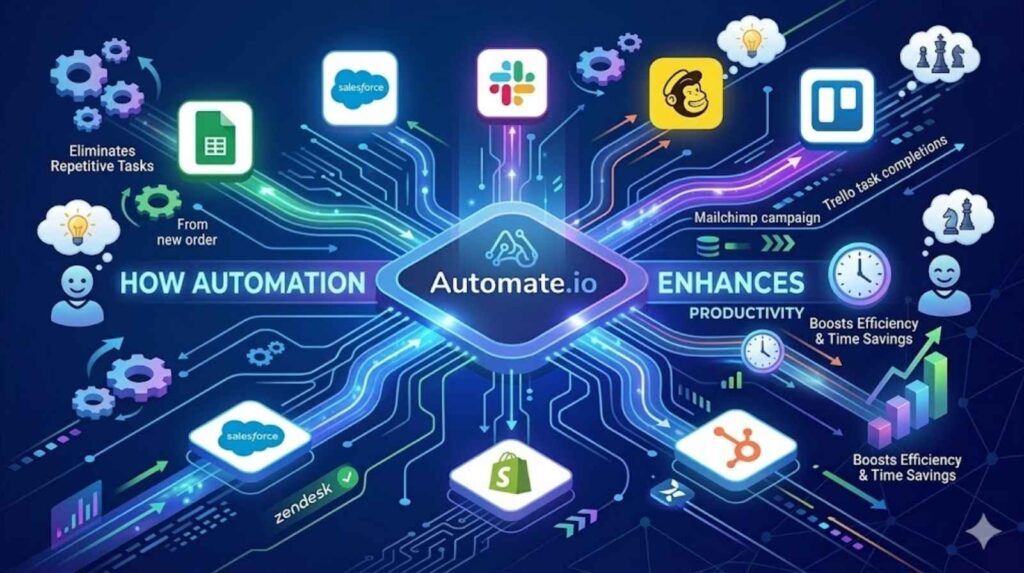
Automation doesn’t just reduce errors. It also saves time. Teams spend fewer hours on repetitive tasks and more time on meaningful work such as strategy, product development, and customer relationships.
Through task automation platforms, organizations can automate routine operations like file organization, report updates, and notification alerts. These improvements lead to stronger business process optimization and higher team productivity.
Case studies: automation in practice
Imagine a company that processes hundreds of support tickets each day. Automation can categorize requests, assign them to the correct team member, and send confirmation messages automatically.
Another example involves sales pipelines. When deals move through stages, automation updates records, schedules reminders, and generates reports. This type of automated customer data management ensures that sales teams always know the status of each opportunity.
Expert insights: why businesses are turning to automation
Automation has moved from a luxury to a necessity. Companies that adopt automation early often gain a competitive advantage. They can respond faster, operate more efficiently, and scale operations without increasing staff.
Many analysts now consider automation a core component of modern digital strategy. Businesses increasingly rely on automate io business automation software to connect their tools and streamline workflows.
Business efficiency and why it matters
Efficiency plays a major role in business success. When processes run smoothly, teams can accomplish more with fewer resources.
Automation helps eliminate repetitive tasks such as copying data, updating spreadsheets, and sending notifications. This leads to faster operations and better business workflow automation across departments.
Experts weigh in
Technology leaders often emphasize the importance of automation in digital transformation. They argue that companies must embrace automation to remain competitive in rapidly evolving markets.
Platforms offering automate.io features and benefits help organizations implement automation without technical complexity. This lowers the barrier for businesses looking to modernize their workflows.
The global trend towards automation
Automation adoption is increasing worldwide. Companies across industries—from retail to healthcare—are automating workflows to improve efficiency.
The rise of multi-app workflow automation shows how organizations are connecting multiple systems to create intelligent processes that run automatically.
Real-world applications and benefits
Automation supports many business activities, including marketing campaigns, customer onboarding, and inventory tracking. These automated processes improve consistency and reduce manual effort.
Through marketing automation integration, companies can schedule campaigns, track engagement, and manage customer interactions automatically.
Pros and cons of automation
Like any technology, automation comes with advantages and challenges.
Benefits often include:
- Reduced manual work
- Improved accuracy
- Faster processes
- Better data management
However, businesses must also consider setup complexity and workflow planning to ensure successful implementation.
Building a tech-savvy workforce
Automation works best when teams understand how to use it effectively. Organizations often train employees to design workflows and manage integrations.
With proper training, staff members can build automated workflows that improve operations and encourage innovation.
User stories: real-world examples of automate io in action
Automation becomes easier to understand when you see it in action. Real companies use these tools every day to streamline operations and improve productivity.
These examples show how automate io helps teams connect systems and eliminate repetitive work.
Jenny’s journey with Automate io at a fast-growing startup
Jenny works at a startup managing marketing campaigns. Her team struggled to track leads across multiple tools. They adopted automation to simplify their workflow.
With automation, new leads automatically enter their CRM, trigger welcome emails, and update dashboards. This small change saved hours of manual work each week.
Raj’s experience in India with collaboration tools
Raj manages remote teams working on multiple projects. Keeping track of tasks across different platforms used to be frustrating.
By integrating collaboration apps and calendars, Raj created automated workflows that keep everyone informed. Notifications, updates, and task assignments now happen automatically.
Rebecca streamlines e-commerce operations
Rebecca runs an online store selling handmade products. Managing orders and inventory manually became overwhelming as her business grew.
Automation now updates spreadsheets, sends order confirmations, and alerts suppliers when stock runs low. These automated workflows keep her business running smoothly.
Insights from Michael on improved workflow efficiency
Michael, a business analyst, focuses on improving operational efficiency. He implemented automation workflows connecting analytics tools and CRM systems.
These automated processes generate reports automatically and keep management dashboards updated. As a result, the company reduced reporting time dramatically.
Pros and cons: evaluating automate io
Every automation platform offers benefits and limitations. Understanding both sides helps businesses choose the right solution.
Automation platforms simplify workflows, but they also require thoughtful planning to maximize their value.
Weighing the advantages and drawbacks
Automation tools provide several advantages:
- Easy workflow creation
- Reduced manual tasks
- Improved data accuracy
- Seamless app integrations
Many companies also appreciate the flexibility offered by automate.io automation templates, which speed up workflow setup.
Potential drawbacks and limitations
Despite its benefits, automation requires proper configuration. Poorly designed workflows can create confusion or duplicate tasks.
Another challenge is choosing between platforms such as automate.io alternatives that offer similar functionality.
Balancing the scales
Ultimately, businesses must evaluate their needs before adopting any automation tool. Factors like integration support, workflow complexity, and scalability play an important role.
The goal is to select a platform that supports long-term growth and improves operational efficiency.
Automate io vs alternatives: how it stacks up against the competition
Automation platforms vary in features, pricing, and integration capabilities. Comparing tools helps businesses determine which option fits their workflow needs.
One common comparison is automate.io vs zapier, as both platforms connect multiple apps and automate tasks.
Comparing automation giants: what sets automate io apart?
Each automation platform offers different strengths. Some focus on large enterprise systems, while others prioritize simplicity for small businesses.
Automation platforms differentiate themselves through integration depth, workflow customization, and user experience.
Versatility and user experience
Many automation tools now offer visual workflow builders and drag-and-drop interfaces. These features allow teams to create workflows quickly.
The simplicity of automation platforms encourages wider adoption across departments, including marketing, operations, and customer support.
Cost-efficiency: making automation accessible
Pricing also influences adoption. Some platforms provide flexible plans for startups and growing businesses.
Organizations often compare automate.io pricing plans to determine which solution offers the best balance between cost and functionality.
Customer support and community
A strong support system can make a huge difference when implementing automation. Documentation, tutorials, and active user communities help teams solve problems quickly.
Many users also rely on automate.io automation platform review articles and community discussions to evaluate the platform.
Future-proofing your business with automate io
Automation continues to evolve as businesses adopt new technologies. Integrating automation early prepares companies for future growth.
By building automated workflows today, organizations create scalable systems that adapt as their operations expand.
Future trends in automation: what’s next for automate io?
Automation technology continues to advance. Artificial intelligence, predictive analytics, and smarter integrations are shaping the future of automation platforms.
Businesses are increasingly relying on automation to handle routine operations while employees focus on strategic work.
Automation’s inevitable march forward
Automation adoption will likely continue accelerating across industries. Companies will automate more tasks as software becomes easier to use.
From customer service to inventory management, automation will power many business operations in the coming years.
What experts are saying about the future
Industry experts predict that automation will become a standard feature in most business software. Integrated automation will replace many manual workflows.
These trends suggest that automation platforms will continue expanding their capabilities and integrations.
Future trends to watch
Several emerging trends will shape automation in the coming years:
- AI-powered workflows
- smarter data synchronization
- deeper software integrations
- predictive automation tools
These innovations will make automation more powerful and easier to adopt.
Conclusion
Automation is transforming how businesses operate. By connecting apps, synchronizing data, and automating repetitive tasks, companies can achieve higher efficiency and better customer experiences. Platforms like automate io demonstrate how powerful automation can be when implemented effectively.
As automation technology continues to evolve, organizations that embrace it early will gain a clear advantage. Whether you’re managing marketing campaigns, customer data, or operational workflows, automation offers a practical way to scale operations and focus on what truly matters—innovation and growth.

Riley Vaughn is a tech innovation architect with 12+ years in AI systems, cybersecurity, and SaaS product development. Having led projects for Fortune 500 firms and emerging startups, Riley writes with real-world precision bridging deep technical insight and strategic vision to help readers navigate the evolving landscape of modern technology.


