

Understanding Equity for Founding Engineers in Software Development
If you’re a developer considering joining an early-stage startup, one word will come up constantly equity. It sounds exciting. It sounds lucrative. But honestly, it can also be deeply confusing. Understanding equity for founding engineers isn’t just useful it’s essential if you want to make smart career and financial decisions.
This guide breaks it all down. From how equity works to what you should watch out for, we’ll cover everything you need to know.
Related Post: Advantages of Being a Chief People Officer
The Role of Founding Engineers in Software Startups
Founding engineers aren’t just hired hands who write code. They’re the technical backbone of a startup. They make critical architecture decisions, set engineering culture, and often wear multiple hats developer, product thinker, and sometimes even recruiter. Their contributions in the earliest months can define whether a company succeeds or collapses.
Because of this outsized impact, equity for founding engineers is typically more generous than packages offered to later hires. It reflects the risk these engineers take by joining before the product is proven, before funding is secured, and before any safety net exists. It’s a trade lower immediate salary in exchange for a meaningful stake in what the company could become.
The Pivotal Role of Founding Engineers
Founding engineers shape far more than the codebase. They influence hiring standards, define technical strategy, and help establish the product roadmap. In many cases, they’re the first ones in the office and the last to leave. Their work ethic and technical judgment set the tone for every engineer who joins after them.
This is why startup founders and investors take founding engineer equity seriously. Giving someone a meaningful ownership stake signals trust. It says, “We believe in you enough to make you a part-owner.” That psychological shift from employee to owner can dramatically change how someone shows up to work every day.
Equity Distribution: A Closer Look
Equity distribution in startups isn’t random. It follows a logic based on timing, role, risk, and negotiation. The earlier you join, the more equity you can typically expect. That’s because early employees absorb more uncertainty. A founding engineer who joins when the company is just a slide deck takes on far more risk than someone who joins after a Series A.
It’s also worth knowing that equity comes in different forms. Stock options are the most common for employees. They give you the right to purchase shares at a set price called the strike price after a certain period. Cash equity or restricted stock units (RSUs) are less common at early stages but do appear in some compensation packages. Each structure has its own tax and financial implications that you’ll want to understand clearly.
Exploring Equity Distribution in Startups
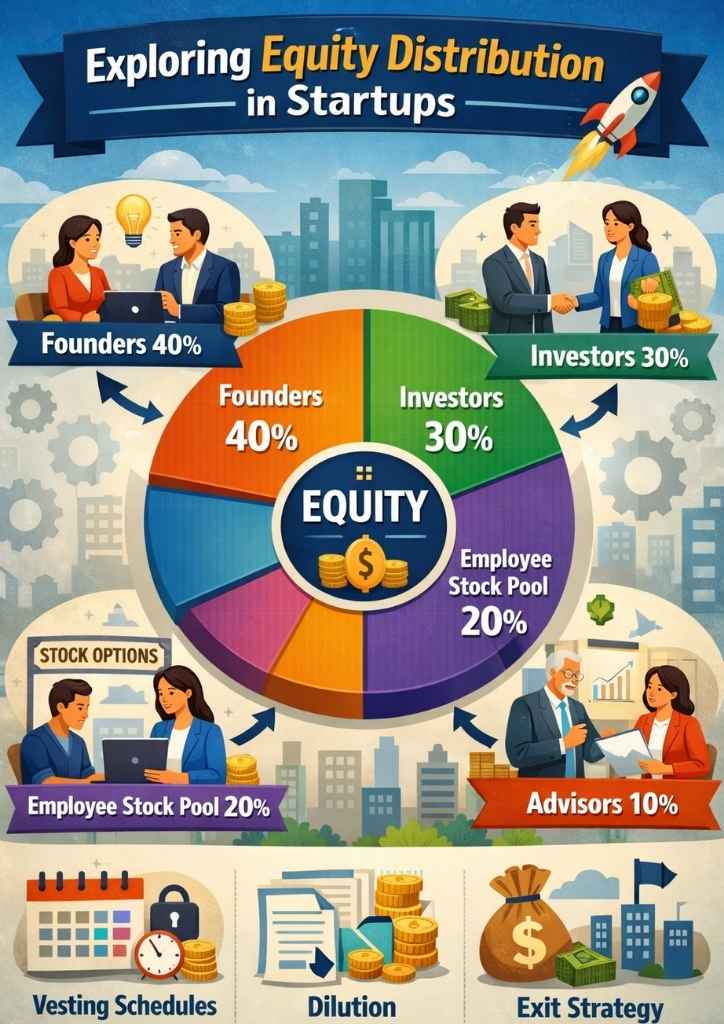
In most early-stage startups, equity for founding engineers typically ranges from 0.5% to 2%, depending on the company’s stage, valuation, and how much cash the engineer is giving up. Some founding engineers at pre-seed companies receive even more, especially if they’re the first technical hire or are stepping into a CTO-adjacent role.
The equity percentage matters, but so does the total share count and the company’s cap table. A 1% stake in a company valued at $50 million is worth far more than a 2% stake in a company that never gets off the ground. Always look at the full picture not just the percentage.
Factors Influencing Equity Allocation
Several variables shape how much equity a founding engineer receives. The startup’s stage is the biggest factor pre-seed companies offer more equity to compensate for higher risk. But your specific skill set matters too. A founding engineer with rare expertise in AI, infrastructure, or security can negotiate a stronger package.
Other factors include your base salary trade-off, the size of the option pool, and how much equity has already been allocated to founders or advisors. If the option pool is small and heavily committed, there’s less room to offer generous grants. Understanding these dynamics before you negotiate puts you in a much stronger position.
Challenges in Equity Allocation
Equity sounds great on paper. In practice, it comes with real complexity. Many engineers accept equity packages without fully understanding what they’ve agreed to and that can be a costly mistake. The challenges range from how long you have to wait to the very real risk that the equity ends up worthless.
Startups also face challenges on their end. Founders must balance being generous enough to attract top talent while not giving away so much ownership that future funding rounds become complicated. It’s a balancing act that requires constant recalibration as the company grows.
Balancing Equity and Compensation
One of the toughest decisions a founding engineer faces is how to weigh equity against base salary. Startups often can’t match big-tech salaries, so they compensate with equity. But that trade only makes sense if the company has a realistic shot at growth.
Don’t let excitement cloud your judgment. Ask hard questions. What’s the current valuation? How much runway does the company have? Who are the investors? These aren’t rude questions they’re responsible ones. A thoughtful startup founder will respect you for asking.
Understanding the Vesting Schedule
A vesting schedule determines when you actually earn your equity. The most common structure is four years with a one-year cliff. That means you get nothing if you leave before your first anniversary. After year one, you’ve earned 25% of your total grant. Then equity vests monthly or quarterly until you hit the four-year mark.
This structure protects the company from someone joining, grabbing equity, and leaving after three months. For engineers, it means you need to think about your long-term commitment. If you’re not planning to stay for at least two to three years, the equity math often doesn’t work in your favour.
Market Volatility and Strike Price
The strike price also called the exercise price is the amount you pay per share when you exercise your options. It’s typically set at the fair market value when your options are granted. If the company grows and its valuation rises, your strike price stays the same, which means you can buy shares cheaply and sell them at a higher price.
However, if the company’s valuation drops or stagnates, your options could end up “underwater” where the strike price exceeds the current market value. In that case, exercising your options makes no financial sense. Market volatility is real, and it’s a key risk in any equity for founding engineers discussion.
Equity Pool Dilution
As startups raise funding, they issue new shares. This increases the total number of shares outstanding and reduces everyone’s ownership percentage a process called dilution. It’s normal and expected, but it can sting if you don’t see it coming.
For example, if you own 1% of a company before a Series A round, you might own 0.7% afterward. Your percentage dropped but the overall company value may have risen significantly, so your absolute value could still be higher. Understanding dilution and the difference between percentage ownership and dollar value is critical for any engineer navigating startup equity.
Legal Considerations for Equity Agreements
Legal documentation around equity is dense, but you can’t afford to ignore it. Before you sign anything, make sure you understand exactly what you’re agreeing to. Equity agreements govern everything from how you earn your shares to what happens if the company gets acquired.
One thing many engineers overlook is the difference between Incentive Stock Options (ISOs) and Non-Qualified Stock Options (NSOs). ISOs offer more favourable tax treatment but come with restrictions. NSOs are taxed as ordinary income when exercised. The type of options you receive will significantly affect your tax liability down the road.
Legal Frameworks and Equity Agreements
A well-drafted equity agreement should cover the number of shares granted, the vesting schedule, the strike price, and any acceleration clauses. Acceleration clauses are especially important they determine what happens to your unvested equity if the company is acquired or if you’re let go without cause.
Single-trigger acceleration means your equity vests automatically upon acquisition. Double-trigger requires both an acquisition and your termination. These details can mean the difference between walking away with significant value or almost nothing. Always consult a lawyer who specialises in startup equity before signing. It’s money well spent.
Future Trends in Equity for Software Engineers
The startup ecosystem is changing fast and so is how companies think about equity. Founders are becoming more sophisticated about structuring compensation. Engineers are becoming more informed about what to ask for. And the broader market is pushing both sides toward more transparency and flexibility.
Remote work has also reshuffled the deck. Startups in lower cost-of-living regions can no longer assume that equity alone will attract top engineers who have competing offers from companies in San Francisco or New York. The conversation around equity for founding engineers is evolving and becoming more nuanced every year.
Emerging Trends in Equity Compensation for Software Engineers
One of the biggest shifts is toward more transparency in equity packages. Platforms and communities are making it easier for engineers to benchmark what’s fair. Startups that aren’t transparent about their cap table or option pool are increasingly seen as red flags.
There’s also a growing interest in extended exercise windows. Traditionally, engineers had 90 days to exercise options after leaving a company often an impossibly short window. Progressive startups are now offering 5 to 10-year exercise windows, which makes equity far more accessible and fair.
Increased Flexibility in Equity Packages
Startups are experimenting with more flexible structures. Some offer a mix of salary and equity with opt-in trade-offs meaning engineers can choose to take less salary in exchange for more equity, or vice versa. This flexibility helps companies attract a wider range of candidates.
Others are exploring performance-based equity grants, where additional shares vest based on milestones or company valuations. While these structures can be motivating, they’re also complex. Engineers should approach milestone-based grants with careful scrutiny and legal guidance.
Focus on Long-Term Incentives
Smart startups are designing equity packages that reward long-term commitment. Beyond standard four-year vesting, some companies offer refresher grants additional equity grants made after year two or three to keep senior engineers engaged and motivated.
This approach acknowledges a simple truth: the engineers who stay and build with you for five or more years create disproportionate value. Rewarding that loyalty with continued equity participation makes sense for both sides and creates a healthier culture of ownership.
Equity as a Tool for Employee Engagement
When engineers feel like owners, they behave like owners. That’s not just a platitude it’s backed by real-world experience. Startups that share equity openly and educate employees about its value tend to see higher engagement, better retention, and stronger team cohesion.
The key is making equity feel real and tangible, not abstract. Regular updates on company valuation, transparent cap table discussions, and honest conversations about dilution and exit scenarios all contribute to a culture where equity actually motivates.
Adapting to Market Conditions
In high-cost markets like San Francisco, equity alone often can’t compete with big-tech total compensation packages. Startups in these markets are rethinking their approach offering higher base salaries, signing bonuses, or faster vesting to remain competitive.
In contrast, startups operating in emerging markets or lower cost-of-living regions sometimes find that equity is a more powerful tool, because the proportional value feels larger relative to local salary benchmarks. Context matters enormously when designing equity strategies.
Case Studies: Success and Lessons Learned
Real-world examples illustrate the stakes better than theory ever can. Some founding engineers have walked away from modest salaries to become millionaires because they understood their equity and stayed the course. Others have left value on the table not because the company failed, but because they didn’t understand the terms of their agreement.
The common thread in success stories is always the same: the engineer asked smart questions early, understood the legal details, and negotiated thoughtfully. The cautionary tales usually involve someone who signed quickly, left before vesting was complete, or didn’t realise their options would expire.
Case Study 1 Early Negotiation Pays Off: A founding engineer at a Series A startup negotiated a 1.2% equity stake with a double-trigger acceleration clause. When the company was acquired three years later, that clause meant her unvested shares fully vested resulting in a seven-figure payout she wouldn’t have received under a standard agreement.
Case Study 2 The 90-Day Trap: A mid-level founding engineer left a startup after two and a half years. He had vested 62% of his options but couldn’t afford to exercise them within the 90-day window. He walked away with nothing. Had the company offered a longer exercise window, the outcome would have been very different.
Case Study 3 Dilution Without Understanding: A founding engineer held 1.5% of a promising startup. By the time it reached Series C, his stake had diluted to 0.4%. He hadn’t modelled the dilution impact and felt blindsided even though the company’s valuation had grown. Understanding dilution math from day one could have shaped his expectations more realistically.
Conclusion
Equity for founding engineers represents one of the most powerful and misunderstood forms of compensation in the tech world. Done right, it aligns your success with the company’s growth and can generate life-changing returns. Done wrong, it becomes a source of frustration, confusion, or missed opportunity.
The good news is that understanding equity isn’t reserved for lawyers and finance professionals. With the right knowledge, you can negotiate smarter, read agreements more confidently, and make decisions that genuinely serve your long-term interests. Whether you’re evaluating your first startup offer or renegotiating an existing package, take the time to understand every term. Your future self will thank you.

Riley Vaughn is a tech innovation architect with 12+ years in AI systems, cybersecurity, and SaaS product development. Having led projects for Fortune 500 firms and emerging startups, Riley writes with real-world precision bridging deep technical insight and strategic vision to help readers navigate the evolving landscape of modern technology.


