

Understanding and Calculating Compa Ratio for HR Leaders
Modern HR leadership is no longer just about hiring and employee relations. Today, it also involves data-driven decision making. Compensation analytics has become one of the most important tools for ensuring fairness and competitiveness in the workplace. For many organizations, Understanding and Calculating Compa Ratio for HR Leaders is a key part of building a smart employee compensation strategy.
When HR leaders use compensation metrics effectively, they gain a clear view of how employee salaries compare to internal pay ranges and market benchmarks. This insight helps organizations maintain internal pay equity, improve workforce compensation planning, and create fair salary structures that motivate employees and retain top talent.
Related Post: Exploring the Role of a Fractional Chief Information Security Officer
The strategic chro
The role of a Chief Human Resources Officer (CHRO) has evolved dramatically in recent years. Today’s CHRO isn’t just responsible for HR policies or recruitment. Instead, they act as strategic partners in shaping business outcomes. One of the ways they do this is by managing compensation management strategy and ensuring employee pay aligns with company goals.
A strategic CHRO relies heavily on HR salary analytics and compensation benchmarking metrics to make informed decisions. Tools such as salary benchmarking tools and HR pay benchmarking systems allow leaders to analyze employee salary comparison data and maintain competitive pay structures. These insights are essential when developing strategic workforce compensation plans that support long-term organizational growth.
What is Compa Ratio?
Compa ratio is one of the most widely used HR compensation metrics for evaluating salary positioning. In simple terms, it measures how an employee’s salary compares to the midpoint of the salary range for their job role. This comparison helps HR teams understand whether an employee’s pay falls below, at, or above the market benchmark.
Organizations rely on this metric during salary range analysis and compensation framework development. It plays a major role in ensuring employees are paid fairly within the company’s employee pay structure while also aligning with external market salary benchmarking.
Decoding the Basics of Compa Ratio
Many HR professionals ask the same question: what is compa ratio in HR? The answer is straightforward. It is a mathematical comparison between an employee’s salary and the salary range midpoint defined for their role.
This metric provides the compa ratio meaning in compensation management. If an employee earns exactly the midpoint salary, their compa ratio is 1.0 or 100%. If their salary is lower, the ratio drops below 1.0. This simple calculation allows HR leaders to quickly assess whether salary adjustments may be necessary.
The Importance of Compa Ratio for CHROs
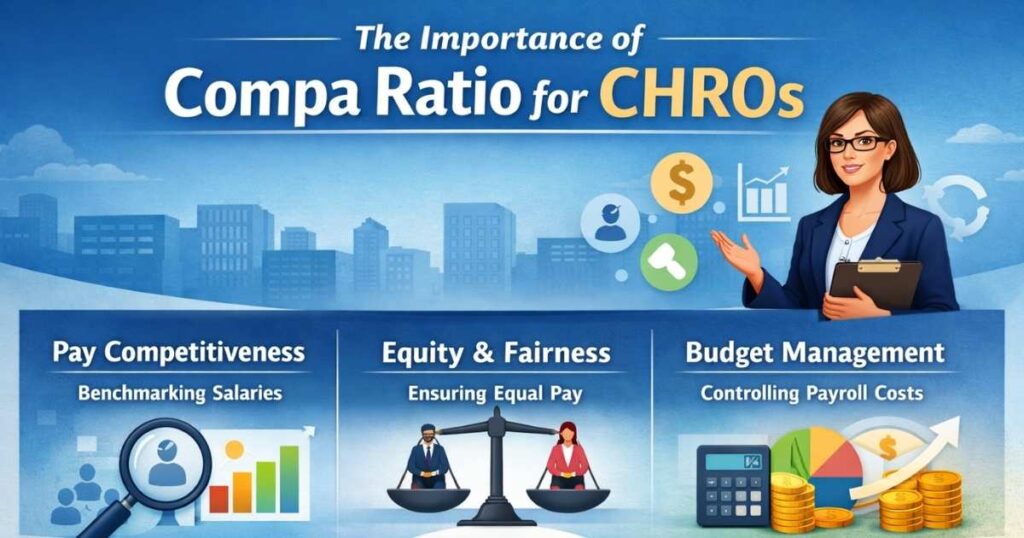
For HR leaders, compensation decisions must balance fairness, competitiveness, and budget constraints. That’s where compa ratios become valuable. They provide insight into whether salaries align with market expectations and internal pay structures.
When organizations conduct pay equity analysis using compa ratios, they can identify salary gaps or inconsistencies across departments. This ensures employees performing similar roles receive fair compensation and supports a healthy HR pay alignment strategy.
The Significance of Compa Ratio for Effective CHRO Strategy
Understanding why compa ratio is important for HR allows leaders to develop stronger compensation strategies. For example, if a company discovers that several employees have ratios below 0.85, it may indicate that salaries are falling behind market rates.
On the other hand, ratios significantly above 1.0 may signal pay scale management issues. CHROs often use group compa ratio analysis to evaluate entire departments and maintain balance in the organization’s compensation strategy for CHRO leadership decisions.
Steps to Calculate Compa Ratio
Learning how to calculate compa ratio is not complicated, but accuracy is essential. HR teams must gather reliable salary data and define clear salary ranges before performing the calculation.
The calculation typically relies on HR pay benchmarking and salary midpoint calculation methods based on market data. Once this information is available, organizations can compare each employee’s salary against the midpoint to determine their relative pay position.
Calculating the Compa Ratio for Optimal Compensation Strategy
The compa ratio formula explained in its simplest form is:
Compa Ratio = Employee Salary ÷ Salary Range Midpoint
Below is a simple example.
| Employee Salary | Salary Midpoint | Compa Ratio |
| $80,000 | $100,000 | 0.80 |
| $100,000 | $100,000 | 1.00 |
| $120,000 | $100,000 | 1.20 |
This compa ratio example in HR shows how salary positioning works. An employee earning $80,000 is paid below the midpoint, while someone earning $120,000 receives compensation above the market midpoint. HR analytics for salary comparison helps organizations evaluate these patterns across the workforce.
Interpreting Compa Ratio Results
Calculating the ratio is only the first step. HR leaders must also interpret compa ratio results carefully to make meaningful decisions. A ratio alone doesn’t always tell the full story because factors such as experience, tenure, and performance also influence compensation.
However, the ratio still offers valuable insight into whether an organization’s salary structure planning aligns with market expectations. It allows leaders to detect salary inconsistencies and improve compensation planning for HR leaders.
Deciphering the Meaning Behind Compa Ratio Results
Understanding compa ratio above or below 1 meaning is essential for accurate analysis.
- Below 1.0 – Salary is below the midpoint
- 1.0 – Salary is exactly at the midpoint
- Above 1.0 – Salary is above the midpoint
Many organizations consider the ideal compa ratio percentage to fall between 0.90 and 1.10. Ratios outside this range may require adjustments or deeper investigation. HR teams also compare compa ratio vs range penetration to better understand an employee’s progression within a salary range.
Challenges in Using Compa Ratio
Although compa ratio is a powerful tool, it isn’t perfect. HR professionals sometimes struggle with data accuracy or incomplete market salary benchmarking information. Without reliable market data, compa ratio calculations may produce misleading insights.
Another challenge arises when organizations rely too heavily on ratios without considering individual performance or specialized skills. Compensation decisions must combine quantitative metrics with human judgment.
Addressing Potential Pitfalls in Utilization
To overcome these challenges, HR leaders should combine compa ratios with other HR compensation metrics. For example, performance evaluations, tenure data, and industry salary benchmarks provide valuable context.
Regular salary range analysis and updates to compensation benchmarking metrics also ensure the organization’s employee pay structure remains competitive. When used correctly, compa ratio in compensation management becomes a powerful decision-making tool.
Best Practices for Implementing Compa Ratio in HR Strategy
Organizations that use compa ratios effectively typically follow a structured process. They integrate the metric into broader workforce compensation planning rather than treating it as a one-time calculation.
Consistent monitoring helps companies maintain fair salary structures and improve internal pay equity. HR leaders who adopt strategic workforce compensation frameworks can ensure their compensation systems evolve alongside changing market conditions.
Implementing Compa Ratio Strategies Effectively
Several best practices can improve compa ratio usage:
- Use reliable market salary benchmarking data
- Conduct regular employee salary comparison reviews
- Integrate ratios into compensation framework development
- Train managers on compensation analytics
When organizations follow these practices, they create stronger HR pay alignment strategies and maintain competitive pay structures.
Ct chro settlements: understanding the process and outcomes
In some cases, compensation disputes lead to formal complaints or legal settlements. CHRO settlements often involve disagreements over workplace practices, discrimination claims, or pay disputes.
Understanding the settlement process helps HR leaders address issues proactively. Transparent policies, consistent compensation management strategies, and documented HR processes reduce the risk of legal challenges and improve trust within the organization.
Chro salary fortune 500: a deep dive into executive compensation
Executive compensation varies significantly across industries, but Fortune 500 companies often provide insight into the upper end of HR leadership pay. CHRO salaries in large corporations typically include base pay, bonuses, stock options, and long-term incentives.
These compensation packages reflect the strategic importance of HR leadership. As organizations increasingly rely on data-driven compensation strategies, CHROs play a vital role in guiding enterprise-wide pay decisions.
Understanding the chro complaint process: a comprehensive guide
When employees believe workplace policies have been violated, they may file complaints through HR channels. The CHRO complaint process ensures concerns are addressed fairly and consistently.
HR departments typically investigate complaints, gather evidence, and determine appropriate actions. Maintaining transparency and clear communication throughout the process strengthens employee trust and reinforces workplace accountability.
Understanding the Importance of a Compa Ratio Calculator in HR
Manual calculations can become time-consuming for large organizations. That’s why many HR teams rely on digital compa ratio calculators. These tools automatically analyze salary data and generate compensation reports.
For organizations focused on Understanding and Calculating Compa Ratio for HR Leaders, calculators simplify the process and improve accuracy. They also integrate with salary benchmarking tools and HR analytics platforms, making it easier to manage large datasets.
The Role of Centralized HR in the Career of a Chief Human Resources Officer
Centralized HR structures help organizations standardize policies and maintain consistent compensation frameworks. By consolidating HR operations, companies improve salary structure planning and streamline compensation management processes.
For aspiring CHROs, experience in centralized HR environments often provides valuable exposure to workforce analytics, pay scale management, and enterprise-level decision making.
Addressing Challenges in the HR Training Process
Training HR teams on compensation analytics is essential for effective workforce management. Without proper training, staff may struggle to interpret compensation benchmarking metrics or conduct accurate salary comparisons.
Organizations that invest in HR education build stronger teams capable of managing complex compensation strategies and data-driven decision making.
Crafting Effective Workforce Strategy Maps for CHROs
Workforce strategy maps help HR leaders align talent management with business objectives. These frameworks connect recruitment, training, compensation, and performance management into a unified strategy.
When compa ratios are included in workforce strategy planning, organizations gain a clearer view of how pay decisions influence employee engagement and retention.
Crafting Effective Compensation Strategies for HR Leaders
Developing a strong compensation strategy requires balancing financial resources with employee expectations. HR leaders must evaluate market salary trends, internal pay structures, and long-term workforce goals.
Data-driven compensation planning enables organizations to maintain competitive salaries while supporting sustainable business growth.
The Importance of Sexual Harassment Training for CHROs
Beyond compensation management, CHROs must ensure safe and respectful workplaces. Sexual harassment training is a critical component of workplace culture and legal compliance.
Regular training programs educate employees about acceptable behavior and reporting procedures, helping organizations prevent misconduct and protect their workforce.
Mastering Netplanning for a Successful Chief Human Resources Officer Career
Strategic planning tools such as netplanning help HR leaders forecast workforce needs and align HR initiatives with company goals. These tools often incorporate workforce data, compensation analysis, and employee performance metrics.
For aspiring CHROs, mastering these analytical approaches strengthens their ability to guide long-term organizational strategy.
Understanding the Art of Setting Targets in HR Leadership
Goal setting plays an important role in HR leadership. Clear targets help organizations measure success in areas such as recruitment, employee development, and compensation management.
Effective HR leaders use measurable targets to guide their teams and ensure HR initiatives contribute directly to business performance.
In-depth Analysis of the Chief Human Resources Officer Career
The CHRO career path combines leadership, strategy, and analytics. Professionals in this role oversee talent management, employee engagement, and organizational development.
As companies increasingly rely on HR analytics and data-driven decision making, CHROs must develop strong analytical skills alongside traditional HR expertise.
Affordable Ways to Boost Employee Engagement
Employee engagement doesn’t always require large budgets. Small changes in workplace culture, communication, and recognition programs can make a significant impact.
Fair compensation practices also play a major role. When employees feel their pay aligns with their contributions and market standards, engagement and productivity often improve.
FAQs
What is a compa ratio in HR?
A compa ratio compares an employee’s salary to the midpoint of their salary range to evaluate pay competitiveness.
How do you calculate compa ratio?
Divide an employee’s salary by the salary range midpoint and multiply by 100 to get the percentage.
What is a good compa ratio?
Most organizations consider a ratio between 0.90 and 1.10 to be within a healthy compensation range.
Why is compa ratio important for pay equity?
It helps HR teams identify salary gaps and maintain fair compensation across similar roles.
What does a compa ratio above 1 mean?
A ratio above 1 indicates that the employee is earning more than the salary midpoint for their position.
Conclusion
Compensation analytics has become a vital part of modern HR leadership. Metrics like compa ratio help organizations maintain fair salary structures, improve internal pay equity, and stay competitive in the talent market. By combining compensation data with strategic workforce planning, HR leaders can build stronger and more transparent pay systems.
Ultimately, mastering compensation metrics empowers HR professionals to make smarter decisions that benefit both employees and organizations. When used thoughtfully, compa ratios support a balanced compensation strategy that drives engagement, retention, and long-term success.

Riley Vaughn is a tech innovation architect with 12+ years in AI systems, cybersecurity, and SaaS product development. Having led projects for Fortune 500 firms and emerging startups, Riley writes with real-world precision bridging deep technical insight and strategic vision to help readers navigate the evolving landscape of modern technology.


