

Understanding the essentials of leadership team development
If you’re a CHRO or senior HR leader, you already know this: strong companies don’t run on individual brilliance. They run on aligned, cohesive leadership teams. That’s why understanding the essentials of leadership team development isn’t just helpful — it’s strategic.
Today’s executive teams face constant pressure. Markets shift. Talent expectations evolve. Transformation never really stops. In this environment, leadership can’t operate in silos. It must function as a unified system. When you invest in leadership team development, you don’t just improve meetings. You strengthen decision-making, culture, and long-term performance.
Related Post: Understanding the Differences: Salaried vs. Hourly Positions in HR Leadership
Defining leadership team development in the HR context
Leadership team development goes beyond executive leadership development programs or one-off workshops. It focuses on how leaders operate together as a collective force. It aligns behavior, strategy, trust, and accountability at the top of the organization.
For CHROs, this is a core part of HR leadership strategy. It connects talent development strategy, succession planning framework design, and organizational leadership growth into one integrated approach. Instead of developing leaders in isolation, you build leadership capability building systems that strengthen the executive team as a whole.
What makes leadership team development crucial in HR?
Many leaders ask, what is leadership team development really about? It’s about turning high-performing individuals into high-performing executive teams. And that requires structure, clarity, and shared purpose.
The role of CHRO in leadership development has never been more strategic. You help align the executive team around business transformation leadership, culture, and long-term priorities. When done right, leadership development strategies for executives create cross-functional team alignment and support strategic HR management at scale.
Key challenges faced by HR leaders in team development
Even experienced HR leaders face real barriers. Executive teams often struggle with misaligned priorities, unclear roles, or inconsistent communication. These are common challenges in executive team development, and they don’t disappear on their own.
In fact, the more senior the team, the more complex the dynamics become. Without intentional leadership effectiveness assessment and team dynamics optimization, friction builds quietly. Over time, performance suffers.
Barriers to Building Cohesive Leadership Teams
One major issue is lack of trust. Building trust in executive teams takes time and courage. Leaders must feel safe challenging each other without damaging relationships. Without that psychological safety, innovation stalls.
Another barrier is poor cross-functional team alignment. Departments protect their interests. Strategy discussions become political. These common leadership development mistakes weaken executive team collaboration and slow organizational culture transformation.
How These Challenges Impact Organizational Growth
When alignment breaks down, decision-making slows. Confusion spreads through the organization. Employees sense disconnect at the top.
This affects employee engagement strategy and long-term retention. It also limits how HR drives organizational growth. Simply put, if the leadership team doesn’t move as one, the organization won’t either.
Core skills required for effective leadership team development
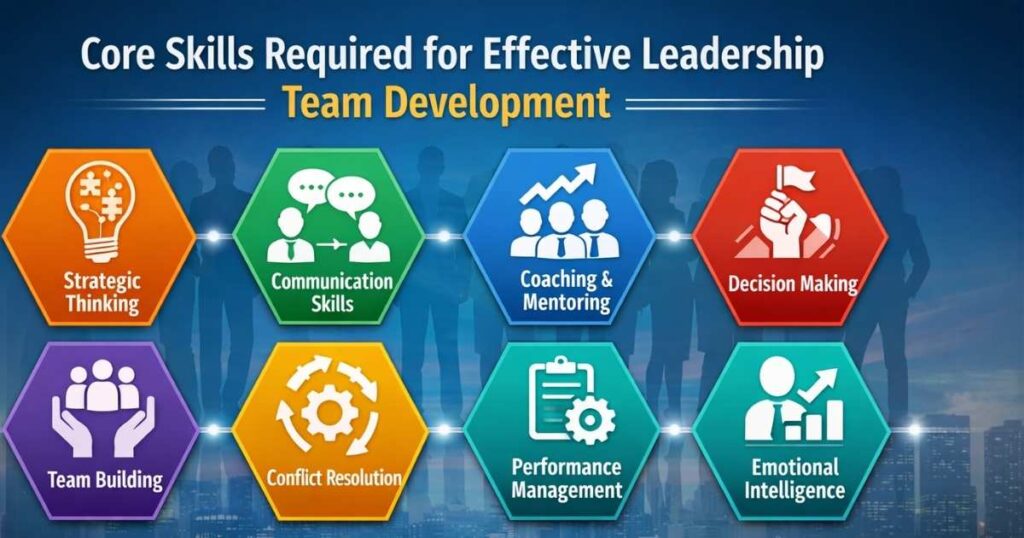
To build future-ready leadership teams, you need more than good intentions. You need skills that translate strategy into action.
Leaders must master strategic thinking skills for leaders. They must balance data with judgment. They must adapt quickly. Change management leadership and business transformation leadership demand agility, not rigidity.
Essential capabilities for driving leadership team success
Emotional intelligence in leadership teams is non-negotiable. Leaders who manage their own reactions create safer, more productive discussions. This directly impacts executive collaboration best practices.
You also need a clear leadership competency model supported by leadership training programs for senior leaders. Coaching, mentoring, and leadership performance metrics help track progress. Together, these capabilities form the foundation of effective understanding the essentials of leadership team development in practice.
Practical strategies for building high-performing leadership teams
If you’re wondering how to build high-performing leadership teams, start with clarity. Define shared objectives. Clarify decision rights. Remove ambiguity.
Then reinforce behaviors through structured learning and development initiatives. A strong talent development strategy combined with a clear succession planning framework ensures you’re developing future leaders internally while strengthening today’s team.
Building Trust and Psychological Safety
Trust doesn’t appear overnight. It grows when leaders model vulnerability. For example, when a CFO openly admits a forecasting error, it signals safety.
Psychological safety strengthens executive team collaboration and improves problem-solving. Without it, even the smartest team will underperform.
Encouraging Cross-Functional Collaboration
Cross-functional projects force leaders to think beyond their silos. They also reveal friction points early.
Regular strategy sessions focused on cross-functional team alignment improve transparency. Over time, this creates stronger leadership team performance indicators and measurable business results.
Investing in Continuous Learning and L&D Initiatives
Leadership isn’t static. Markets evolve. So must your leaders.
Embedding a continuous learning culture in organizations supports leadership capability building. Ongoing leadership development strategies for executives reinforce strategic HR management and long-term resilience.
Structured Team Building Activities
Team building strategies for executives should go beyond surface-level exercises. Strategic retreats, facilitated discussions, and scenario planning build deeper alignment.
When leaders solve problems together, they strengthen executive collaboration best practices and improve organizational leadership growth.
Clarifying Roles and Responsibilities
Ambiguity creates tension. Clear accountability eliminates confusion.
When roles are defined and expectations are explicit, leadership effectiveness assessment becomes easier. Teams spend less time debating authority and more time driving results.
Measuring the impact of leadership team development
You can’t improve what you don’t measure. Measuring leadership development impact ensures your investment produces results.
Start with leadership performance metrics tied to strategy. Use both qualitative feedback and quantitative leadership team performance indicators. Over time, patterns will emerge.
Tracking Progress and Outcomes in Leadership Team Development
Track behavioral changes. Are meetings more focused? Is decision-making faster? Are conflicts resolved constructively?
Leadership development ROI measurement should connect directly to business outcomes. Revenue growth, employee engagement, and innovation output all reflect whether your efforts are working. This is where understanding the essentials of leadership team development becomes measurable, not theoretical.
Common pitfalls and how to avoid them
Even well-designed programs can fail. One major mistake is ignoring culture. Organizational culture transformation must support development efforts. Otherwise, old habits win.
Another issue is treating development as a one-time event. Leadership team development requires consistent reinforcement and adaptation.
Recognizing and Overcoming Common Obstacles
Some leaders resist feedback. Others underestimate the benefits of leadership team alignment. Without honest conversations, progress stalls.
HR strategies for leadership transformation should include structured reflection, coaching, and transparent dialogue. That’s how you build truly future-ready leadership teams.
Practical Steps to Avoid Pitfalls
Involve the executive team in designing development initiatives. This increases ownership.
Also, regularly review outcomes. Adjust your leadership competency model and learning initiatives as the business evolves. Flexibility strengthens strategic HR management and long-term success.
Conclusion
Strong organizations don’t leave leadership alignment to chance. They design it intentionally. For CHROs, understanding the essentials of leadership team development means shaping not only today’s executive performance but tomorrow’s leadership pipeline.
When you align strategy, culture, and capability, everything accelerates. Decision-making improves. Engagement rises. Results follow. In a world that rewards agility, investing in leadership team development isn’t optional — it’s essential.

Riley Vaughn is a tech innovation architect with 12+ years in AI systems, cybersecurity, and SaaS product development. Having led projects for Fortune 500 firms and emerging startups, Riley writes with real-world precision bridging deep technical insight and strategic vision to help readers navigate the evolving landscape of modern technology.


