

Understanding the Importance of Internal Equity in HR Leadership
A Chief Human Resources Officer (CHRO) plays a vital role in shaping an organization’s culture and success. They oversee talent management, employee engagement, and compensation strategies. One key focus for a CHRO is internal equity. This means making sure employees are paid fairly based on their roles, experience, and contributions. When internal equity is strong, employees feel valued and motivated. It also helps attract and retain top talent, keeping the organization competitive.
Internal equity is more than salaries. It includes benefits, professional development, and transparent pay policies. CHROs use tools like salary benchmarking, internal pay audits, and compensation management software to maintain fairness. They also focus on diversity and inclusion to close gender and racial pay gaps. Ultimately, internal equity strengthens trust and performance across the workforce.
Related Post: Exploring Companies with Effective DEI Programs
The Role of Internal Equity in HR Leadership
Understanding and Ensuring Fair Practices in Workplace Compensation
Internal equity sits at the core of any credible compensation strategy. It’s not just about numbers it’s about fairness, perception, and trust. When employees believe their pay reflects the real value of their work relative to their peers, they’re more engaged and less likely to look elsewhere. HR leaders, especially CHROs, play a direct role in building and maintaining that confidence. Without it, even the most attractive total rewards strategy can unravel quickly.
Achieving this starts with clear job role valuation and regular internal pay assessments. These assessments compare compensation across similar roles within the company, flag inconsistencies, and help leadership make informed decisions. Using tools like compa-ratio analysis, HR teams can quickly identify where pay sits relative to the midpoint of a salary range. The goal isn’t to make everyone earn the same amount it’s to make sure differences in pay are based on legitimate factors like experience, performance, and skill level, not bias or oversight.
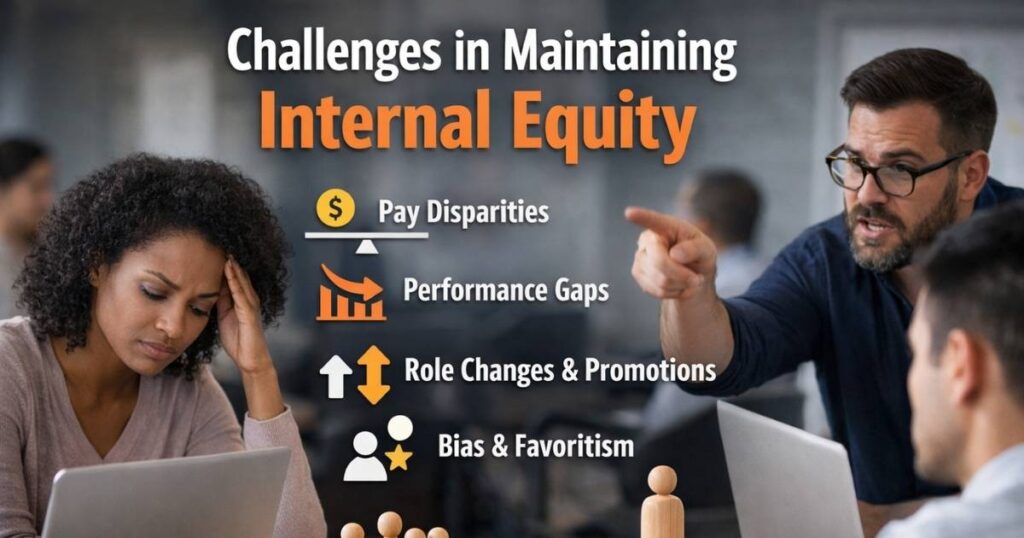
Challenges in Maintaining Internal Equity
Overcoming Barriers in Achieving Fair Compensation
Maintaining fair compensation across a growing workforce isn’t easy. One of the biggest challenges is that pay structures tend to drift over time. When companies hire quickly, offer sign-on bonuses, or fail to conduct regular salary benchmarking, they end up with gaps that are hard to explain and even harder to defend. Long-tenured employees may find themselves earning less than newer hires in the same role. That’s a fast track to resentment.
The gender pay gap and racial pay equity remain serious concerns in many organizations. Pay disparity detection often reveals that these imbalances aren’t always the result of deliberate decisions they’re frequently the outcome of unchecked processes and outdated salary structures. HR leaders need transparent compensation policies and a commitment to regular audits. Pay transparency is increasingly non-negotiable, especially as employees talk more openly about what they earn. Without proactive equity efforts, companies risk both legal exposure and reputational damage.
Strategies for Promoting Internal Equity
Effective Approaches to Ensuring Fair Compensation
Promoting internal equity requires a mix of structured processes and cultural commitment. There’s no single fix it’s an ongoing discipline. Here are proven strategies that HR leaders use to keep things fair:
• Conduct thorough job evaluations: Job role valuation is the foundation. When you clearly define what each role requires, it’s much easier to build salary ranges that make sense.
• Use market salary analysis: External data matters too. Regular salary benchmarking ensures your internal ranges stay competitive and aligned with what the market is paying.
• Build pay transparency into your culture: Employees who understand how pay decisions are made are far less likely to feel they’re being treated unfairly.
• Run internal pay audits regularly: Don’t wait for a complaint to surface. Routine audits catch problems early, before they grow into legal or morale issues.
• Expand your view of compensation: A strong total rewards strategy includes benefits, professional development opportunities, flexible work, and equity compensation metrics not just base salary.
• Engage employees in the conversation: Fair pay practices improve when employees feel heard. Open dialogue about compensation builds loyalty and reduces turnover.
These strategies work best when they’re embedded in HR leadership best practices, not treated as one-off projects. Strategic HR leadership means building equity into every compensation decision, not just reviewing it once a year.
Tools and Technologies Supporting Internal Equity
Tools and Technologies for Ensuring Fair Pay
HR technology has made it significantly easier to identify and address pay imbalances. Compensation management software gives HR teams a clear view of how pay is distributed across roles, departments, and demographic groups. These platforms pull in both internal data and external salary benchmarks, helping leaders make comparisons quickly and accurately. Without this kind of tool, pay gap analysis becomes a manual, time-consuming process and gaps can go undetected for years.
HR data analytics and AI in HR are also changing the game. Predictive models can flag employees who may be underpaid relative to their peers, spot trends before they become problems, and support more consistent salary structure optimization. Platforms focused on pay transparency help employees understand where their pay sits within defined ranges, which reduces confusion and suspicion. AI-driven tools can also factor in performance-based compensation data and workforce equity trends to produce recommendations grounded in real evidence not gut instinct. These technologies don’t replace good judgment, but they make it a lot easier to act on it.
Case Studies: Successful Internal Equity Initiatives
Illustrative Instances of Internal Pay Equity Achievements
One mid-size technology company discovered significant pay disparities after running its first structured pay gap analysis. The HR team found that women in engineering roles were consistently paid below the compa-ratio midpoint compared to their male counterparts in equivalent positions. Rather than making quiet adjustments, the CHRO made the decision to communicate transparently sharing the findings with leadership and affected employees, outlining the correction plan, and setting a timeline for implementation. The result was a notable improvement in employee satisfaction scores and a measurable drop in voluntary turnover.
A global retail brand took a different angle. Facing rapid expansion, it had accumulated a patchwork of salary structures across regions and departments. By investing in compensation management software and integrating HR predictive analytics, the team was able to standardize job role valuation across the organization, align pay ranges with current market salary analysis, and ensure diversity and inclusion in HR decisions informed every step. Within 18 months, internal pay assessment results showed far fewer outliers and dramatically fewer escalations from employees questioning their pay. These examples prove that internal equity initiatives, done right, are good for people and good for business.
Future Trends in Internal Equity for HR Leaders
Emerging Trends and the Future of Internal Equity
The future of workplace fairness is data-driven, transparent, and increasingly regulated. Governments in multiple regions are introducing pay transparency legislation that will require companies to publish salary ranges publicly and in some cases, report on pay gaps by gender and race. HR leaders who haven’t already built strong workforce equity infrastructure will find themselves scrambling. Those who’ve invested early will be in a strong position to comply with minimal disruption.
AI in HR will continue to evolve, with more sophisticated tools for real-time pay disparity detection and salary structure optimization. HR predictive analytics will move beyond reactive audits toward proactive equity management flagging potential imbalances before they materialize. Organizational equity will also expand beyond pay, encompassing access to development opportunities, promotions, and flexible work. For strategic HR leadership, the message is clear: internal equity isn’t a compliance checkbox. It’s a competitive advantage.
Conclusion
Internal equity isn’t a trend it’s a fundamental expectation in the modern workplace. Employees increasingly demand fairness, transparency, and consistency in how they’re compensated relative to their peers. HR leaders who treat this as a priority will build organizations where people genuinely want to stay. Those who ignore it will keep paying the price in turnover, disengagement, and reputational risk.
The good news is that the tools, data, and strategies to get this right are more accessible than ever. Whether you’re running your first internal pay audit, deploying compensation management software, or building a company-wide pay transparency framework every step forward matters. Start where you are, commit to continuous improvement, and remember that fair compensation isn’t just the right thing to do. It’s the smart thing to do.
FAQs
What is internal equity in HR?
Internal equity refers to the fairness of pay across roles within the same organization. It ensures that employees are compensated consistently based on factors like job responsibilities, experience, and performance not arbitrary or biased decisions.
How does internal equity differ from external equity?
Internal equity focuses on pay fairness within the company, while external equity compares your compensation to market salary data. Both matter internal equity builds trust among existing employees, and external equity helps you attract new talent.
What tools help HR leaders manage internal equity?
Compensation management software, HR data analytics platforms, and AI-powered pay gap analysis tools are the most effective options. These technologies enable real-time monitoring, salary benchmarking, and data-driven adjustments to maintain fair pay structures.
How often should companies conduct internal pay audits?
At minimum, companies should run internal pay audits annually. However, high-growth organizations or those undergoing significant hiring may benefit from bi-annual or even quarterly reviews to catch imbalances before they compound.
What role does pay transparency play in internal equity?
Pay transparency reinforces internal equity by ensuring employees understand how compensation decisions are made. When people know what salary ranges exist and how they’re applied, they’re more likely to trust the process and less likely to assume they’re being treated unfairly.

Riley Vaughn is a tech innovation architect with 12+ years in AI systems, cybersecurity, and SaaS product development. Having led projects for Fortune 500 firms and emerging startups, Riley writes with real-world precision bridging deep technical insight and strategic vision to help readers navigate the evolving landscape of modern technology.


